When the Ship Stays in Port: Vessel Emissions, Shore Power and Resident Claims at UK Harbours
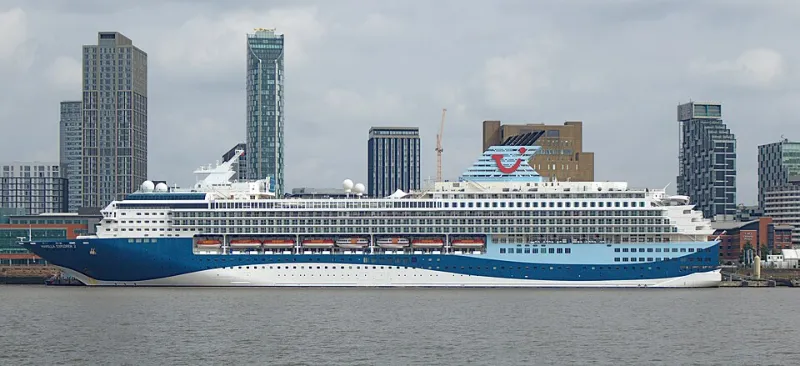
Photo: Rodhullandemu, CC BY-SA 4.0, via Wikimedia Commons
A berthed cruise ship is a small town that has not switched off its engines. Auxiliary generators run to power lighting, air conditioning, galleys and pumps, and the exhaust from those engines is released at low level, often within a few hundred metres of residential streets. For households near cruise terminals, ferry berths and commercial harbours, the result can be long spells of diesel fumes, a persistent low hum and a smell that settles into gardens on still evenings. Shore power — sometimes called cold ironing — is meant to remove much of that burden, but connection dates have a habit of slipping. This article sets out where residents stand in 2026.
Why ports are not like other neighbours
A factory on an industrial estate has one operator, one environmental permit and one local authority to answer to. A port is a mesh of different parties. The harbour authority controls navigation and berthing. The terminal operator runs the quay and the passenger buildings. The shipping line owns or charters the vessel. The grid operator and electricity supplier determine whether shore power can be delivered at the capacity required. Each has a different legal relationship with the residents living beyond the fence, and each will tend to point at the others when a complaint arrives.
That fragmentation matters. It means a single letter to a single company rarely resolves anything. It also means that a well-documented complaint, sent to the right bodies in the right order, can achieve more than residents expect.
When vessel emissions become a statutory nuisance
Section 79 of the Environmental Protection Act 1990 lists the matters that can constitute a statutory nuisance. The most relevant here are fumes or gases emitted from premises so as to be prejudicial to health or a nuisance, and noise emitted from premises in the same way. Whether a moored vessel counts as "premises" is a question of fact and degree, and it is not settled in every scenario; a ship permanently berthed and used as a floating hotel is a different proposition from a ferry that stays for ninety minutes. In practice, local authority environmental health officers tend to look at the effect on the complainant rather than at the technical status of the hull.
The assessment is usually about frequency, duration and intensity. A plume that drifts across a street for ten minutes once a fortnight is unlikely to clear the threshold. Fumes that arrive for four hours on every turnaround day, week after week through the summer, are a different matter. Officers will consider wind direction, the height and position of the funnel, the distance to the nearest homes, and whether the exposure is interfering with the use and enjoyment of property.
There is also a statutory defence of best practicable means, which can apply to fumes and gases from premises used for trade or business. Operators will invoke it. The defence is not a blank cheque: it requires evidence of what was considered, what was costed and why alternatives were rejected. A line that has deferred shore power for several consecutive seasons may find that defence harder to sustain than it once was.
Shore power: promise, delay and who is accountable
Shore-power schemes require heavy infrastructure: cables, converters, substations and a grid connection capable of delivering several megawatts to a single berth. Funding rounds, planning permissions and network reinforcement all take time, and announcements frequently run ahead of delivery. Residents reading that a terminal will be "shore-power ready" should ask a precise question: ready for which berth, for which vessel class, and from what date?
Delayed connection does not automatically create a compensation claim. What it can do is strengthen a nuisance complaint, because it undermines the argument that everything practicable is already being done. Environmental Information Regulations 2004 requests to the port, the local authority and any public funding body can be useful here. Ask for correspondence about shore-power delivery dates, grid capacity studies, and records of complaints received about berth emissions.
Building an evidence log that will be taken seriously
Contemporaneous records carry far more weight than a retrospective account written after a difficult summer. A practical log should capture:
- Date, start and end time of each episode, with the vessel name if it is visible or can be identified from a tracking app.
- Wind direction and strength at the time, taken from a local weather station or a simple handheld anemometer.
- What was experienced: odour, visible haze, eye or throat irritation, soot deposits on windowsills or washing, and noise.
- Photographs and short videos with timestamps, taken from the same vantage point where possible so that patterns emerge.
- A note of any medical appointments or lost sleep, kept factual rather than emotive.
Where budgets allow, a calibrated low-cost particulate monitor can add a defensible numerical thread, provided it is sited sensibly and its limitations are acknowledged. Readings are supporting material, not a substitute for a witness account.
The routes available and what each can deliver
The local authority. A formal nuisance complaint under section 79 should trigger an investigation. The authority can serve an abatement notice, require works, and prosecute for breaches. It cannot award compensation; that requires a separate civil claim.
The harbour authority and the Maritime and Coastguard Agency. These bodies have roles in port marine safety and vessel compliance, including fuel sulphur limits under MARPOL Annex VI. They are not nuisance regulators, but they can act on concerns about excessive auxiliary running or non-compliant fuel use.
Planning and permit routes. Planning conditions attached to terminal expansion, and environmental permits for associated plant, may contain operating restrictions. Breach can be raised with the planning authority.
A civil claim in nuisance. Compensation for diminution in property value, loss of amenity, and in some cases personal injury is theoretically available. Such claims are expensive, slow and fact-heavy, and limitation periods apply: six years for nuisance damage to property and three years for personal injury. Specialist advice should be taken early.
A realistic view for 2026
Most port-side complaints are resolved, where they are resolved at all, through sustained pressure on the operator and the local authority rather than through litigation. The households that fare best are those that document consistently, complain in writing to named bodies, and persist across seasons. Shore-power delivery remains the single most effective remedy, and scrutiny of delivery timetables is a legitimate and useful form of resident pressure.